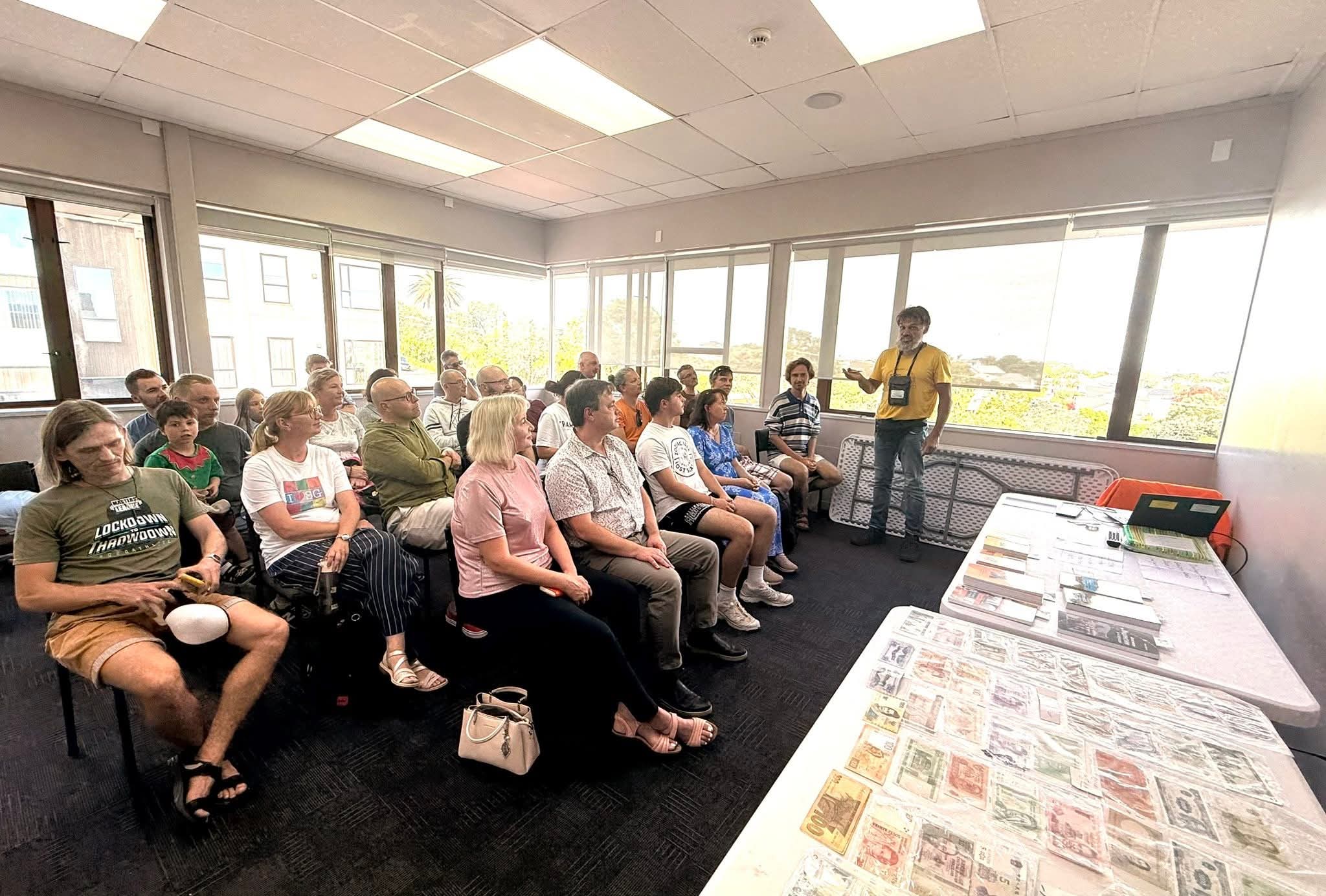
New Zealand became the 153rd country visited by traveler Anton Krotov. A countercultural internet phenomenon since the mid-1990s, he has explored the world by decidedly unconventional – and often uncomfortable — means: hitchhiking and staying with strangers (vpiskas). His travels have taken him far beyond the ordinary, but he speaks about them with infectious enthusiasm, as he did during two lectures at Auckland’s Nash Dom (“Our Home”) Cultural Center.
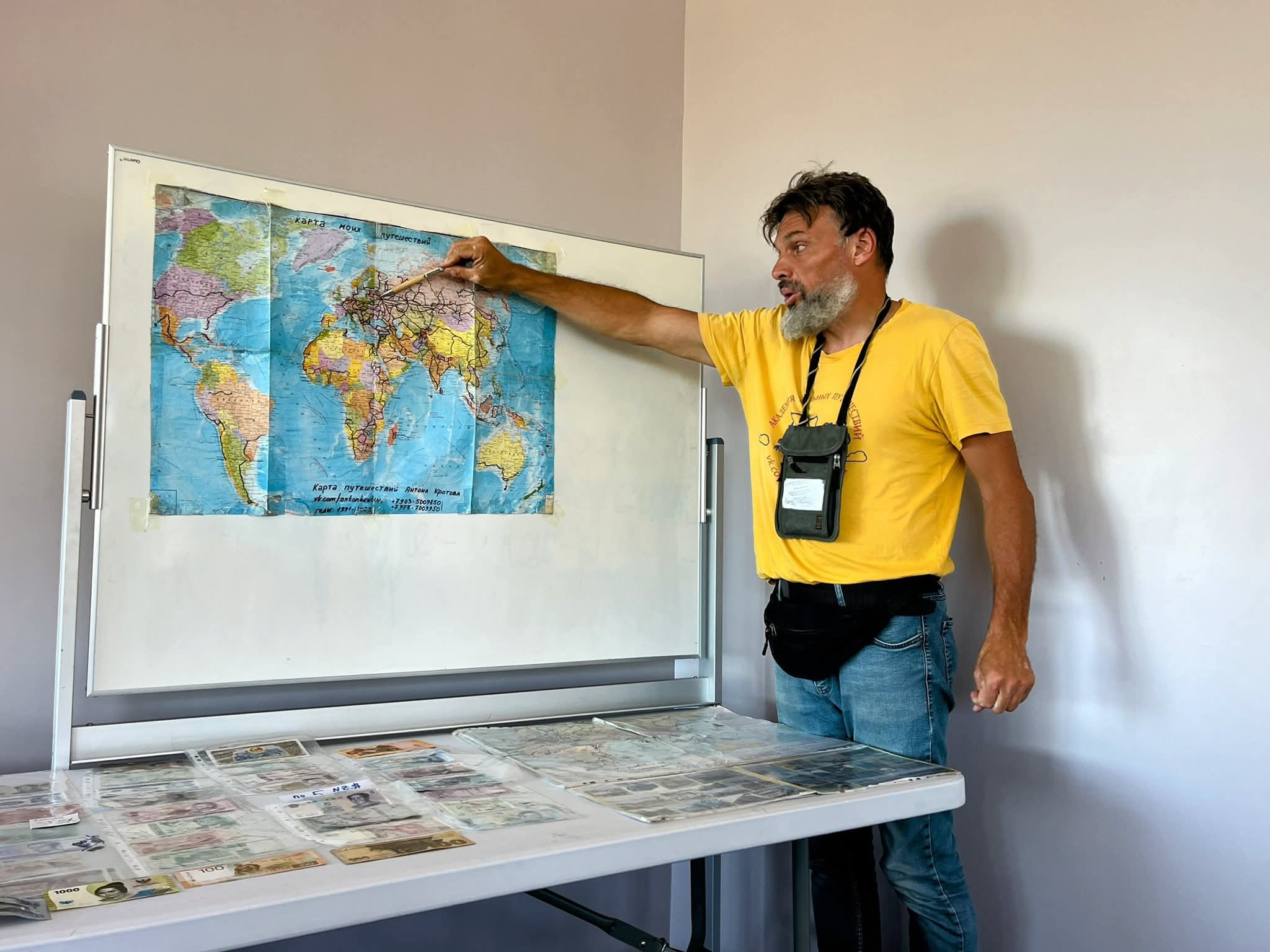
With his unruly hair, bushy beard and breakneck speaking pace, Krotov radiates so much energy that it is hard to imagine how he manages to keep up with himself. Behind him, a table is piled with books. He has written 68 of them, although he could hardly have brought them all to Auckland. A world map hangs on the wall, marked with some of his routes in his own hand. There is no need for glossy graphics or elaborate presentation: they would only consume precious time — time that, in Krotov’s view, should be spent doing as much as possible. The message can be conveyed much more simply.
Complexity is simply not Anton Krotov’s style. One of his two most important books bears the decidedly unglamorous title Solving Problems the Simplest Way. It is about stripping life down to its essentials and organizing around one overriding goal. Everything else goes under the knife. Looking for a partner? Don’t rush into attachments—they limit you. Pets? They limit you. Education? The desire for a better life? They limit you too. “EVERYTHING CAN BE DONE CHEAPER”, Krotov writes in his guide in bold capital letters. To solve problems in the simplest way, every element of the journey must serve a purpose. If it doesn’t, it is removed from the mechanism.
Work out what you want from life and start doing it now. Make a plan and stick to it. Be unwavering in your purpose. Be patient. Don’t drink. Live your own life. As he speaks, it is impossible not to think that Krotov could be an extraordinarily powerful motivational speaker. Yet the clichés of 21st-century life seem entirely alien to him. He appears to have arrived from a parallel universe—one without seven-figure mortgages, weekend supermarket runs or leisurely days on the beach with a compulsory view of Mount Tongariro. “Choose life”; life tells him.”Choose a job. Choose a career. Choose a family. Choose”. Life insists — A big-screen TV: “But why do I need any of that?” Krotov asks. “I chose not to choose life. I chose something else”. “Travel”, Krotov argues. “Is a method of extending human life by intensifying it?”. His particular method of intensifying life is certainly not for everyone. “In Mali, he says, you can rent a house for two dollars a day. Quit your job and go to Mali”.
Go to Mali. Go to Afghanistan, Krotov says. Go to Madagascar. Go to Namibia. “The narrower the roads, the simpler and better the people”, he tells us – and keeps talking, talking, and talking, at a thousand words per minute. His frantic rhythm sweeps the listener along. Unexpected pronouncements and sudden turns — “Afghanistan is one of the best countries in the world!” – jolt you out of your comfort zone and force you to think, question, argue.
Or simply to reflect — and agree. That is, if you have time to reflect. If not, the sheer velocity of his storytelling wraps itself around you and carries you away. Anton Krotov has been traveling since the mid-1990s and lecturing about his experiences for almost as long. He is only partly a motivational speaker; his persona is much larger than that. Over the past three decades, despite – or perhaps because of — his ascetic lifestyle, a genuine cult of personality has grown around Krotov and his philosophy of freedom through global movement. He does not seem particularly troubles by it. According to Krotov, thousands of people visit his Moscow apartment every year—”the most visited apartment in Moscow”, as he proudly points out. And yet Anton Krotov hardly comes across as a man interested in the fuss surrounding him. If anything, it seems to distract him from what really matters. At times, he seems to take a corner too fast. In Solving Problems, Krotov writes: “The four Gospels describe many miracles, but only one miracle appears in all four: Jesus feeding five thousand people with five loaves of bread. …Well, hundreds of people come to our Forest Sober Gathering, knowing that there will be food for everyone“.
Yes, sometimes it seems as though he takes a corner too fast, but there is a strong suspicion that Anton Krotov does not even notice it. He hurtles through the fabric of the Universe like a comet—appearing out of nowhere, flashing across the sky and vanishing into the nowhere, spreading light, asking nothing of anyone, yet leaving no one indifferent.
You cannot help having an opinion about a comet. You might never form an opinion about an oak tree that was growing in a clearing before you were born and will still be growing after you are gone. But a comet streaks past and disappears, setting the imagination alight and leaving behind a trail of questions. Where did it come from? What was it for? Where was it going?
A comet has no destination. Only a trajectory.
Igor Zelenitsyn, Auckland (Translated by Elena Naumova)